
There is no single, verified net worth figure for 'Raddington Group' today, and that's not a gap in the research, it's the research finding itself. The name appears in several unrelated contexts, and the most likely explanation for most searches is that 'Radington Group' or 'Raddington Group' is a misspelling of Redington Group, a well-documented Indian technology distribution and supply-chain services company headquartered in Chennai.
Raddington Group Net Worth: How to Estimate It

Marcus Delany
27 May 2026

If that's what you're looking for, Redington's market capitalization on the BSE/NSE has historically ranged between roughly $700 million and $1. 2 billion USD depending on share price movements, with annual revenues exceeding $8–10 billion USD in recent fiscal years. If you're researching a different entity using the Raddington name, the honest answer right now is: verifiable financial data is thin, and any specific number you've seen cited elsewhere almost certainly lacks a documented source.
What the Raddington Group actually is (and the misspelling problem)
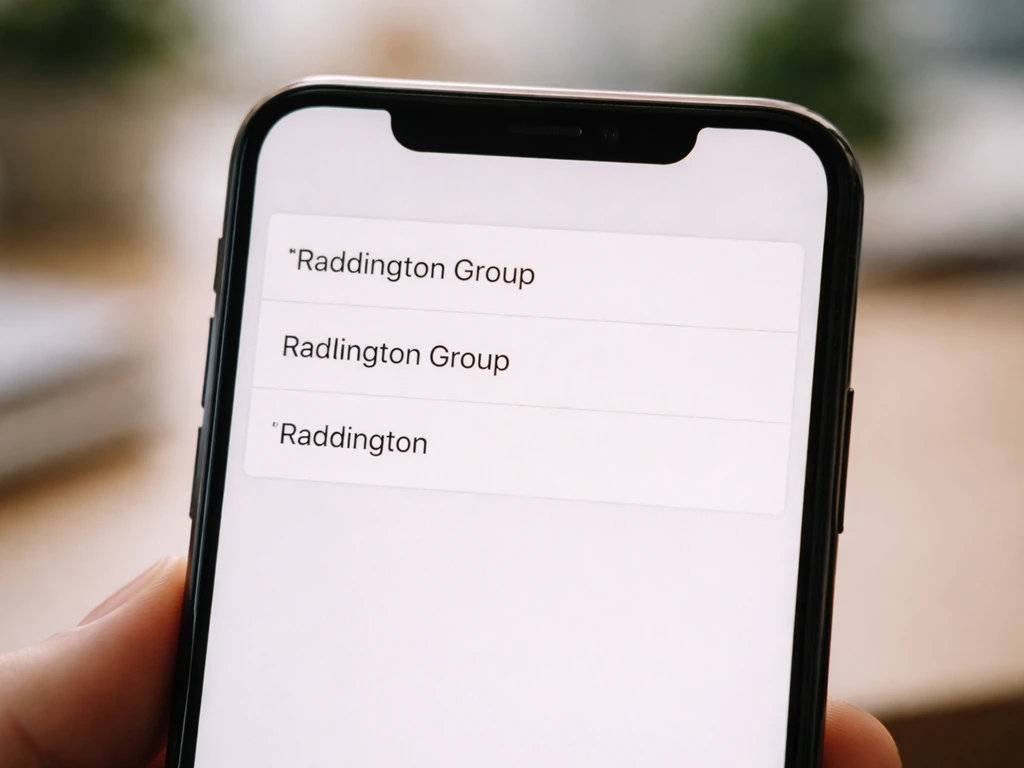
When I dug into this, I found at least three distinct entities using variations of the 'Radington' or 'Raddington' name, which is exactly the kind of thing that turns a simple net-worth question into a research puzzle. First, there's a live website at raddingtongroup.
com that appears to be a branded business, but its publicly accessible content doesn't match the profile of a major corporate group with documented financials. Second, there's 'Radington Industrial Consulting, s. r. o.
', a registered company in Slovakia operating under radington. sk, which is a consulting firm, not a large investment group. Third, 'Radington' shows up as a conference brand through events companies like Ahlam Business Solutions, meaning the name is also used for event series rather than a single corporation. Ahlam Business Solutions lists “[Radington Conference](https://www.
ahlambiz. com/)” as an events offering, supporting the idea that “Radington” can function as a conference or brand name rather than a single corporate group.
The strongest signal pointing toward a misspelling comes from a placement-drive page that lists 'Radington Group, Gurugram' and then links directly to redingtongroup. com. That's a very common pattern: a recruiter or campus-placement coordinator types the name phonetically, and it sticks in search indexes and databases. Redington Group is a real, publicly listed company with audited financials, stock exchange disclosures, and years of press coverage.
If your search for 'Raddington Group net worth' is really about Redington, the data exists and is traceable. If your goal is the lake rucker family net worth, look for independently verifiable sources rather than a single unsourced figure. If it's about one of the smaller or newer entities using the Raddington branding, the situation is fundamentally different and requires a different research approach.
Why net worth is hard to pin down for private groups
Net worth for an individual is straightforward in concept: assets minus liabilities. For a corporate group, especially a private one, that calculation gets complicated fast. Private companies are not required to publish audited financial statements in most jurisdictions. They don't have a share price that the market updates in real time. Ownership is often spread across founders, silent partners, holding companies, and family trusts in ways that are deliberately opaque. A group might own real estate, equipment, intellectual property, and equity stakes in other businesses, and valuing each of those accurately requires information that simply isn't public.
There's also a conceptual trap that catches a lot of people: confusing company value with personal net worth. If a founder owns 60% of a business valued at $50 million, their stake is worth $30 million on paper, but only if someone actually buys it at that price. Until a transaction happens, that number is an estimate, not a bank balance. This distinction matters a lot when you're reading net-worth figures published online for private-group owners or family-controlled businesses.
The figures you see on sites like ours for comparable family wealth cases, think along the lines of family-controlled holding groups similar to what's covered in profiles of family business dynasties, are always presented as ranges precisely because this uncertainty is real, not a hedge.
What you can realistically estimate: revenue, assets, and ownership stakes

Even without a full financial disclosure, you can build a defensible range by gathering what is available. The key inputs are revenue (or turnover), profit margins, identifiable hard assets, known liabilities, and the ownership structure. For a group like Redington (the likely target for most searches), all of these are publicly available through stock exchange filings. For a smaller private entity using the Raddington name, you'd be working with fragments: company registry filings that may show registered capital, any court records that reference asset values, press mentions of contracts or transactions, and comparative benchmarks from similar businesses in the same sector and geography.
- Revenue: The top-line number tells you the scale of the business. A company doing $10 million in annual revenue is valued very differently from one doing $500 million, even at the same profit margin.
- Profit margins: Net profit as a percentage of revenue is what actually drives valuation. Consulting firms often run 10–25% net margins; distribution businesses like Redington typically run much thinner margins, often 1–3%, but on enormous volumes.
- Hard assets: Real estate, machinery, inventory, and cash on the balance sheet can be valued more objectively than intangibles. Asset-heavy businesses often have a valuation floor based on liquidation value.
- Liabilities: Debt, lease obligations, and contingent liabilities subtract directly from enterprise value to get to equity value (what the owners actually own).
- Ownership stakes: If a group is owned by multiple partners, a holding company, or a family trust, the personal net worth of any individual is their percentage of equity value, not the full company value.
Credible sources to check right now
Here's where I'd start if I were building this estimate today. The goal is to triangulate from multiple independent data points rather than relying on any single source, especially any source that doesn't explain where its number came from.
- Business/company registries: For a Slovak entity like Radington Industrial Consulting, check the Slovak Business Register (orsr.sk) for registered capital, filing history, and ownership records. For a UK or Isle of Man entity, Companies House is free and highly detailed. For Indian companies, the Ministry of Corporate Affairs (mca.gov.in) holds incorporation documents and annual filings.
- Stock exchange filings: If you're researching Redington Group (BSE: 532805 / NSE: REDINGTON), its annual reports, quarterly earnings, and investor presentations are all publicly filed and freely downloadable. These give you audited revenue, profit, debt, and asset figures.
- Court records: Litigation involving a company often surfaces asset valuations, debt amounts, and ownership disputes that never appear in press releases. Public court databases in the relevant jurisdiction are worth checking.
- Press and trade media interviews: Founders and executives often cite revenue milestones or valuation figures in interviews with business publications. These are not audited numbers, but they provide a useful anchor.
- Commercial databases: Platforms like Dun & Bradstreet, Orbis (Bureau van Dijk), or Crunchbase aggregate registry data and sometimes include estimated revenue ranges for private companies. These are estimates, not audited figures, but they can anchor your range.
- Domain and trademark registrations: WHOIS data and trademark filings can confirm when a brand was established, in which jurisdictions, and sometimes who the registrant is — useful for confirming whether you're looking at a legitimate operating business.
How private-company valuations actually work

There are three main valuation frameworks used for private companies and investment groups, and each gives you a different answer depending on the nature of the business. Understanding which method applies to your target is as important as the numbers themselves.
| Method | Best For | Core Formula | Key Limitation |
|---|---|---|---|
| Asset-Based | Holding companies, real-estate groups, asset-heavy businesses | Total assets minus total liabilities = net asset value | Undervalues businesses where earnings power exceeds book value of assets |
| Income-Based (DCF) | Businesses with predictable, recurring cash flows | Present value of projected future cash flows, discounted at a risk-adjusted rate | Highly sensitive to growth and discount-rate assumptions; small changes = big swings |
| Market Comparables (Multiples) | Businesses in sectors with publicly listed peers | Apply an industry EV/EBITDA or P/E multiple to the subject company's financials | Requires finding genuinely comparable companies; multiples vary widely by market conditions |
For a consulting or industrial-services business like Radington Industrial Consulting, a market-comparables approach using EV/EBITDA multiples of 5x–10x (typical for small-to-mid-size consulting firms in Europe) would be a starting point. For a distribution group like Redington, the publicly traded share price already reflects the market's valuation, so no estimation is needed, you just read the market cap. The asset-based method is most appropriate when a group primarily holds real estate or financial assets rather than operating a business.
How to interpret the estimates you find (and the red flags to watch for)
Any net-worth figure you find for a private group should come with a range, not a single precise number. A range like '$50 million to $150 million' is more honest and more useful than '$87.4 million' because the latter implies a precision that simply doesn't exist without audited data and a formal valuation. When I see a suspiciously specific number attached to a private company with no source, that's a red flag, not a sign of superior research.
- Copy-paste estimates: Many financial-trivia sites generate numbers algorithmically or copy from each other. If five sites all show the exact same figure with no methodology explanation, the number is almost certainly unverified.
- Revenue confused with net worth: A company doing $500 million in annual revenue is not worth $500 million. Net worth (equity value) is revenue minus costs, multiplied by a valuation multiple, minus debt. Conflating the two is one of the most common errors in online financial profiles.
- 'Insider' claims without documentation: Phrases like 'according to sources close to the company' or 'industry insiders estimate' without a named, verifiable source should be treated as speculation.
- Static numbers that never update: Private-company valuations change with market conditions, interest rates, and business performance. A figure published in 2019 and still circulating unchanged in 2026 is almost certainly stale.
- Mixing personal wealth with company value: If a founder owns 40% of a business, the company's value is not their personal net worth. Always check whether a figure refers to the enterprise value of the whole entity or the equity stake of an individual.
Build your own estimate: a practical starting point
If you want to produce a defensible range yourself, here's the process I'd use starting today. It won't give you a certified appraisal, but it will give you something far more reliable than most of what circulates online.
- Confirm which entity you're researching. Search company registries in the most likely jurisdictions (India via MCA, Slovakia via orsr.sk, UK via Companies House) to confirm registration details, ownership, and filing history. Verify whether you mean Raddington Group (raddingtongroup.com), Radington Industrial Consulting in Slovakia, or Redington Group (the publicly listed Indian distributor).
- Pull any available financials. For Redington, download the latest annual report from redingtongroup.com or the BSE filing database. For smaller entities, registry filings may show registered/paid-up capital, which is a floor, not a ceiling, but it's a start.
- Identify comparable companies. Find 3–5 publicly listed businesses in the same sector and geography. Note their EV/EBITDA or P/E multiples. These become your valuation benchmarks.
- Apply the right method. For an asset-heavy holding group, use asset-based valuation. For an operating business with revenue, apply a conservative comparable-company multiple to EBITDA if you can find or estimate it.
- Adjust for ownership and debt. If the group has known debt (check court filings or press mentions), subtract it from enterprise value. If you're estimating a founder's personal net worth, apply their ownership percentage.
- Express the result as a range. Use a low case (conservative multiple, higher debt estimate) and a high case (optimistic multiple, minimal debt) to bracket the answer. For most private groups of moderate size, the range will be wide — accept that as honest rather than trying to narrow it artificially.
- Document your sources and assumptions. A well-sourced estimate with acknowledged limitations is far more valuable than a precise-sounding number with no paper trail.
This kind of structured estimation is the same approach we use here when covering wealth profiles across industries, whether that's for business-owning families or investment groups where full financial disclosure doesn't exist. It's worth noting that the challenge you're encountering with Raddington Group is not unique: many family-controlled business groups operate with intentionally minimal public footprint, which is why doing the registry-and-filings legwork is so important before accepting any figure you find cited online.
If you're specifically searching for the Minnesota Rusco family net worth, it's best to treat any claims as unverified until you can match them to credible financial records. If you're specifically looking for the rangos family of 12 net worth, the same approach applies: gather verifiable documents and treat any un-sourced figure as a preliminary estimate. The research process itself usually tells you more than the number at the end.
FAQ
How can I confirm whether “Raddington Group” is actually “Redington Group” before trusting a net-worth number?
Check whether the spelling links to a stock exchange listing, audited filings, or a known corporate website tied to the same headquarters and business description. If the only evidence is a placement, campus drive, or a random directory entry, treat it as a misspelling until you can match the entity to a verifiable issuer or registry record.
If I find a specific “net worth” figure online for a private Raddington entity, should I trust it if it sounds precise?
Usually no. For private groups, highly specific numbers without an audit reference, valuation date, or methodology are often fabricated or copied. A safer approach is to require a stated valuation basis (asset appraisal, transaction multiple, or equity stake valuation) and a date, otherwise you can only treat it as an unverified claim.
What’s the difference between company valuation (enterprise value) and personal net worth of a founder?
Company valuation reflects the value of the whole business or equity, while personal net worth depends on the founder’s actual ownership percentage, debt in personal holding structures, and whether the stake is liquid or restricted. A founder might “own” 60% of an estimated business value, but their personal net worth can be far less if the shares are illiquid, pledged, or held through complex entities.
For a consulting or industrial-services firm using the Raddington name, how do I choose an EV/EBITDA multiple to estimate value?
Use multiples from comparable companies that match size, geography, and client type, then adjust for margins and growth. Also be careful with EBITDA quality, if the consulting firm has heavy pass-through costs or one-time expenses, reported EBITDA can overstate earning power, which inflates the multiple-based value.
When should I use an asset-based estimate instead of earnings-based (multiple) methods?
Use asset-based methods when the group’s value is dominated by real estate, cash, investments, or long-term holding of equity stakes rather than ongoing operating earnings. If revenue comes mostly from service work, an asset-only approach will understate the value because it ignores earning potential.
How do I deal with ownership complexity, like holdings, trusts, and minority stakes, when estimating net worth?
Map the ownership chain from the public or registry entity you can verify, then identify each layer of control. Minority stakes require an additional discount and sometimes lack voting power. If you cannot verify who ultimately owns the shares or assets, convert your estimate into a range and clearly state which assumptions are unknown.
What “range” width is realistic when financials are limited for a private group?
A narrow range usually requires at least one credible anchor (like a verified transaction price, audited statements, or a reputable valuation report). Without that, wider bands are more defensible, for example 3x or more variance in valuation, because both revenue/profit and asset values can be uncertain and biased in different directions.
What documents or records are most useful for triangulating a smaller Raddington-branded company?
Start with official company registry filings (registered capital, directors, address), any available financial statements filed locally, property or asset records if accessible, and court filings that reference asset values or contractual disputes. Supplement with credible mentions of contracts, acquisitions, or financing events, because they provide valuation anchors beyond marketing pages.
If the group name appears on an events or conference brand, can I still estimate net worth for “Raddington Group”?
Not reliably. An events brand may be a marketing umbrella rather than an operating holding company. In that case, the “net worth” of the brand is not the same as the finances of the organizing entity, so you need to identify the legally responsible company behind the events.
How do I avoid confusing “revenue” with “profit” when estimating net worth?
Revenue alone rarely determines value. You need profit indicators like operating margin, EBITDA, or net income, then apply a valuation method consistent with the business model. If you only have turnover, your estimate should remain a broad range because profit margins can vary drastically between similar-looking companies.
Next Article
Minnesota Rusco Family Net Worth: Estimate and Sources
Estimate Minnesota Rusco family net worth with sources, income and assets, plus a photo-based verification checklist.